
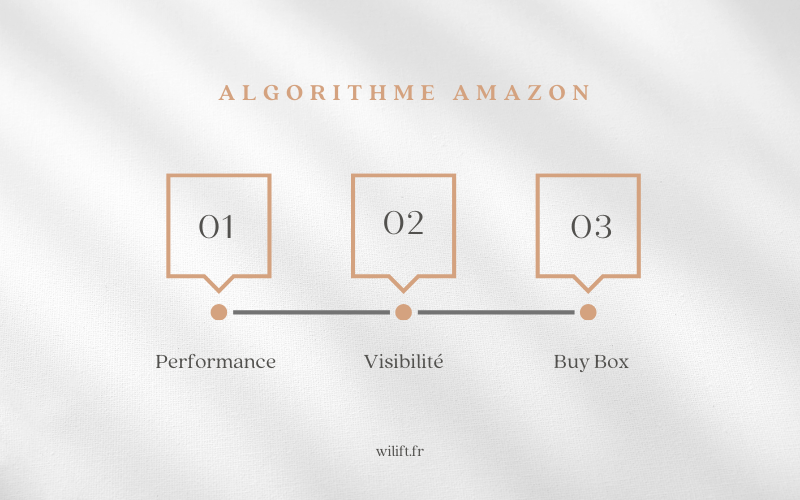
En 2026, the Amazon algorithm has definitively turned the page on keyword stuffing-based SEO. From now on, the Buy Box and ranking are based on a simple but demanding principle: the actual performance observed by Amazon, at each stage of the customer journey.
For a founder or e-commerce manager, this means one thing: Optimizing Amazon is no longer a matter of technical SEO, but of overall business strategy.
Context: Why Amazon changed its algorithm in 2026
Amazon faces a dual challenge. On the one hand, an explosion in the number of sellers in Europe. On the other, increasingly demanding consumers in terms of reliability, delivery times, and shopping experience.
To maintain customer trust, Amazon has gradually adjusted its algorithm in order to reward brands that sell well, sustainably, and cleanly.
So theAmazon algorithm 2026 Buy Box no longer trying to find out who knows how to optimize a profileMore who truly deserves visibility.
Current situation: how the Amazon algorithm actually works in 2026
To understand theAmazon's algorithm in 2026First, we must abandon a still widespread misconception: Amazon does not "rank" products like a traditional search engine. Unlike Google, whose goal is to provide the best information, Amazon primarily seeks to Maximize the likelihood of purchase while guaranteeing an impeccable customer experience..
In concrete terms, the Amazon algorithm constantly analyzes what is happening after the clickIn other words, it doesn't just determine if a product matches a search query, but observes whether that product sells well, consistently, and without generating friction. This is the logic of real performance which now structures the entire ranking and the allocation of the Buy Box.
1. Sales velocity: a key indicator for understanding Amazon ranking
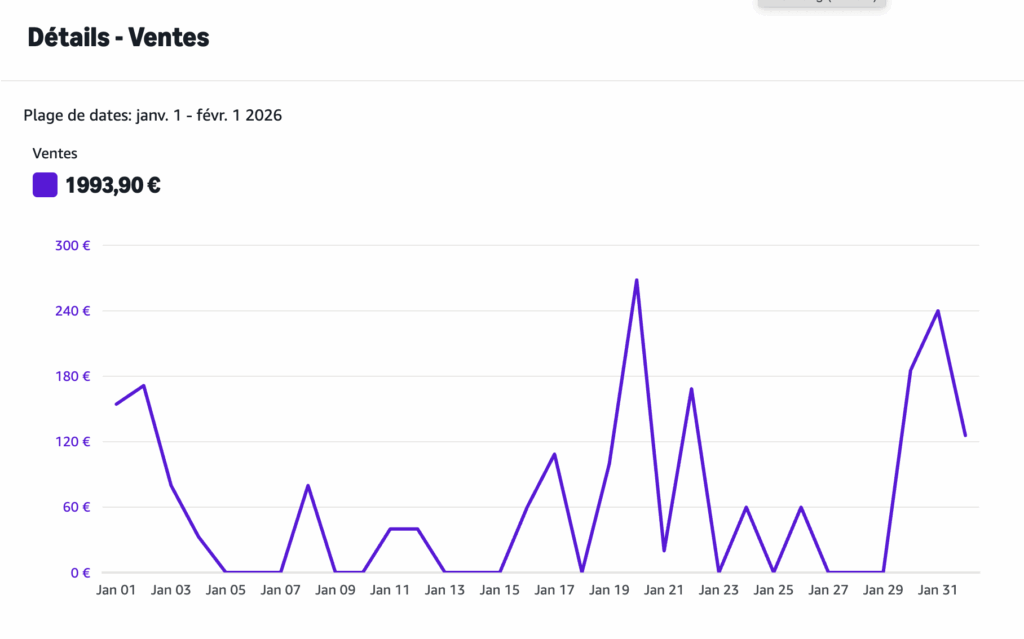
Among the most decisive signals in 2026 is the sales speed (sales velocityThis concept may seem abstract to a non-specialist, but it is nevertheless central. sales speed is now one of the most powerful levers in the Amazon algorithm. Contrary to popular belief, Amazon doesn't just value sales volume, but above all their regularity over timeSales velocity refers to a product's ability to generate orders continuously over a given period, not to a one-time peak.
A brand capable of generating a constant order flow sends a clear signal to the algorithm: the product meets a real and stable demandAmazon prioritizes its own products because this reduces the risk of stockouts, excessive returns, or customer dissatisfaction. Therefore, a product that sells less frequently but consistently may rank higher than a product that experiences a sales spike followed by a sharp decline.
This logic explains why some brands fail despite aggressive advertising campaigns: if sales are not sustained over time, the algorithm interprets this as a lack of fit between the product and the actual market demand.
According to several industry analyses, products showing continuous sales growth over 7 to 14 days benefit more quickly from an improvement in their organic ranking and enhanced access to the Buy Box.
2. Behavioral signals at the heart of Amazon ranking
However, sales speed alone is not enough. Amazon also relies on a multitude of behavioral signals to refine its ranking. These signals allow the algorithm to measure the quality of the experience offered to users.
By 2026, Amazon's search engine optimization (SEO) relies heavily on post-click behavioral signals :
- click-through rate (CTR),
- conversion rate,
- time spent on the sheet,
- Interactions with images and A+ content,
- navigation after purchase.
In other words, Amazon measures what users actually do, and not what the product description “promises”.
For example, Amazon analyzes whether users click on a product page, take the time to view images, read A+ content or reviews, and, most importantly, complete their purchase. A product that attracts attention but doesn't convert sends a negative signal, even if it has good semantic ranking.
This is precisely why keyword stuffing has become ineffective. In 2026, Amazon SEO is inextricably linked to conversionA good ranking is no longer the cause of sales, but the consequence of purchasing behavior deemed satisfactory by the algorithm.
This is where theAmazon algorithm 2026 Buy Box clearly distinguishes itself from Google: The content is not judged on its structure, but on its commercial effectiveness.
3. The impact of artificial intelligence on the Amazon algorithm
To this behavioral logic is now added another structuring factor: artificial intelligence. Thanks to AI, Amazon is able to interpret thepurchase intention in a much more nuanced way than before. It's no longer simply a matter of matching a query to a keyword, but of understanding what problem the user is actually trying to solve.
Algorithms no longer simply associate a query with a keyword: they analyze the context, past behavior, and the probability of satisfaction.
Therefore, a product description focused solely on technical specifications, without context or a clear benefit, can be penalized if it fails to meet the buyer's implicit expectations. Conversely, content structured around uses, concrete situations, and customer benefits tends to perform better, even with an equivalent number of keywords.
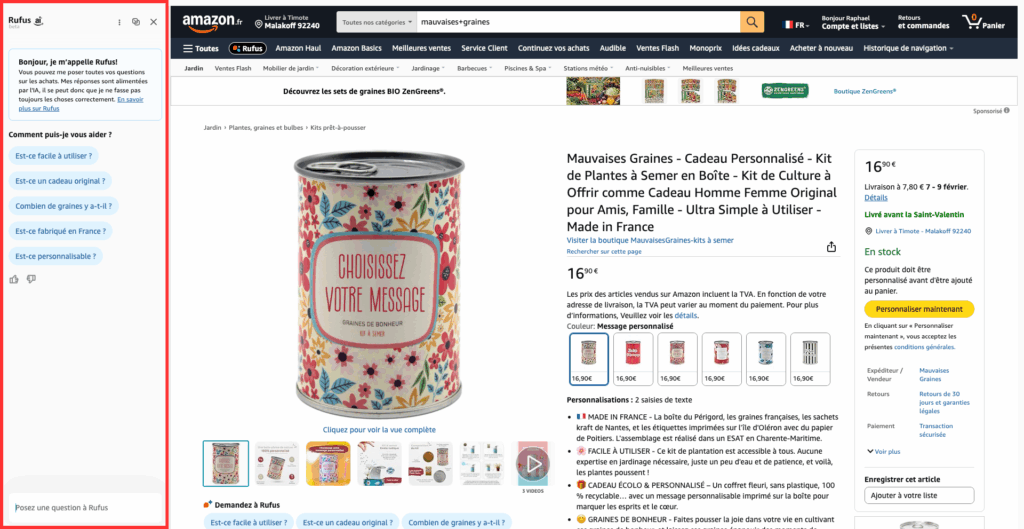
This evolution explains why Amazon increasingly favors brands capable of offering a clear, consistent and user-oriented message, rather than those that are content with purely technical optimizations.
To conclude:
- Generic content loses its effectiveness.
- Problem-solving oriented worksheets perform better.
- Brands that structure their message around real-world usage gain visibility.
Buy Box 2026: a strategic challenge, not just a price
4. Understanding the Buy Box in 2026: Beyond Price
La BuyBox It remains one of the most powerful performance levers on Amazon, but its operation is often misunderstood. Many founders still believe that simply offering the lowest price is enough to win it. In reality, contrary to a still widespread belief, the lowest price is no longer enough to keep the Buy Box.
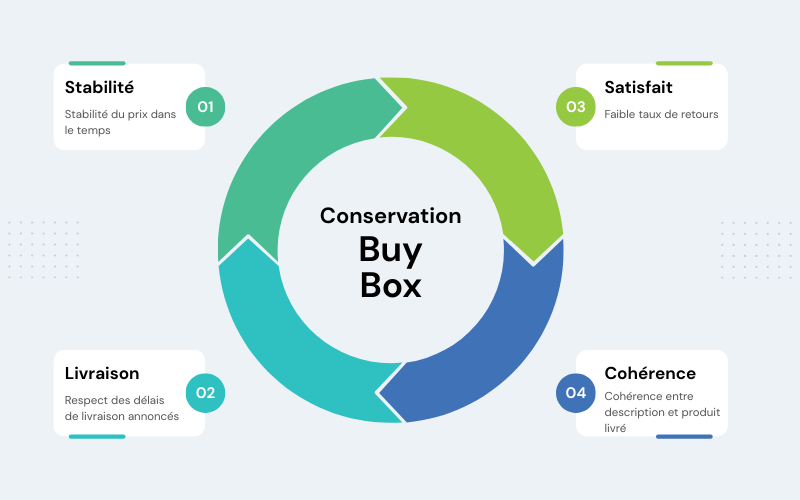
Amazon now prioritizes the better balance between customer value and operational reliabilityAmong the key criteria observed:
- price stability over time,
- adherence to announced delivery deadlines
- low return rate,
- consistency between description and delivered product.
In 2026, the Buy Box is allocated based on a overall balance between price, reliability and customer experienceAmazon seeks to minimize risks: delivery delays, excessive returns, disputes, or negative reviews. A slightly more expensive but more reliable seller can therefore win the Buy Box against a cheaper but unreliable competitor.
This logic leads Amazon to favor brands capable of demonstrating operational consistency over time, rather than opportunistic strategies focused solely on pricing.
5. Logistics and customer service: structural levers of performance
The Buy Box is heavily influenced by a brand's ability to deliver on its promises.
In this context, logistics plays a crucial role. Efficient inventory management, on-time delivery, and the ability to absorb demand spikes are all positive signals sent to the algorithm. Using solutions like FBA, or a well-executed hybrid logistics strategy, significantly reduces friction and mechanically increases the likelihood of winning the Buy Box.
Furthermore, customer service quality has become an indirect but crucial metric. Amazon analyzes message response times, return handling, and problem resolution. A responsive and well-structured seller account inspires confidence, not only in customers but also in the algorithm.
Strategic advice for adapting to the Amazon algorithm by 2026
Faced with these developments, it becomes essential to adopt a comprehensive and structured approach. Amazon can no longer be managed as simply another sales channel. It must be considered as a ecosystemin which every decision — marketing, logistics or editorial — has a direct impact on visibility and profitability.
Key points to consider in your strategy:
- prioritize sustainable performance over artificial peaks.
- design product pages as conversion tools,
- align advertising, SEO and user experience
- to manage overall profitability via TACoS rather than isolated ACoS,
- Anticipate logistical constraints to avoid any disruption.
Conclusion: What the Amazon algorithm really reveals in 2026
The Amazon algorithm 2026 Buy Box sends a clear message to the founders: Amazon no longer rewards superficial optimization, but real performance.
The brands that succeed are those that understand that Amazon is first and foremost a data-driven ecosystemwhere every decision impacts visibility, profitability and long-term growth.
Do you want to know if your Amazon account is aligned with the 2026 algorithm requirements? Wilift supports brands from A to Z : strategic audit, conversion optimization, Ads & Buy Box management, profitable scaling.
Contact us for a personalized diagnosis and identify your hidden growth levers.
A really good blog and me back again.
Thanks! Follow us for more relevant information.
Very good, I like it.