
Amazon has just reached a discreet but strategic milestone. With Amazon Shop Brand SitesThe platform is testing a new feature: displaying products from brand websites directly in the Amazon app, even if these products are not sold on its marketplace.
In practice, a user searches for an item in the app. They can't find it on the marketplace. Amazon then offers them a direct link to the brand's official website to complete the purchase. In other words, Amazon sends its own users to a third-party site.
This change may seem minor. In reality, it reveals a clear ambition: Amazon wants to remain the gateway to every shopping journey.even when the transaction takes place outside of its ecosystem.
For brand founders, CMOs, and Heads of E-commerce, this raises a direct question: your Amazon and DTC strategy Is it still suitable? This article deciphers the three key impacts of Amazon Shop Brand Sites for your brand.
What are Amazon Shop Brand Sites?
Amazon Shop Brand Sites This is a feature currently in beta. It is available to a limited group of US users on the Amazon iOS and Android app. Specifically, it allows products from brand websites, including products, to appear in search results. absent from the Amazon catalog.
How do Amazon Shop Brand Sites work in the app?
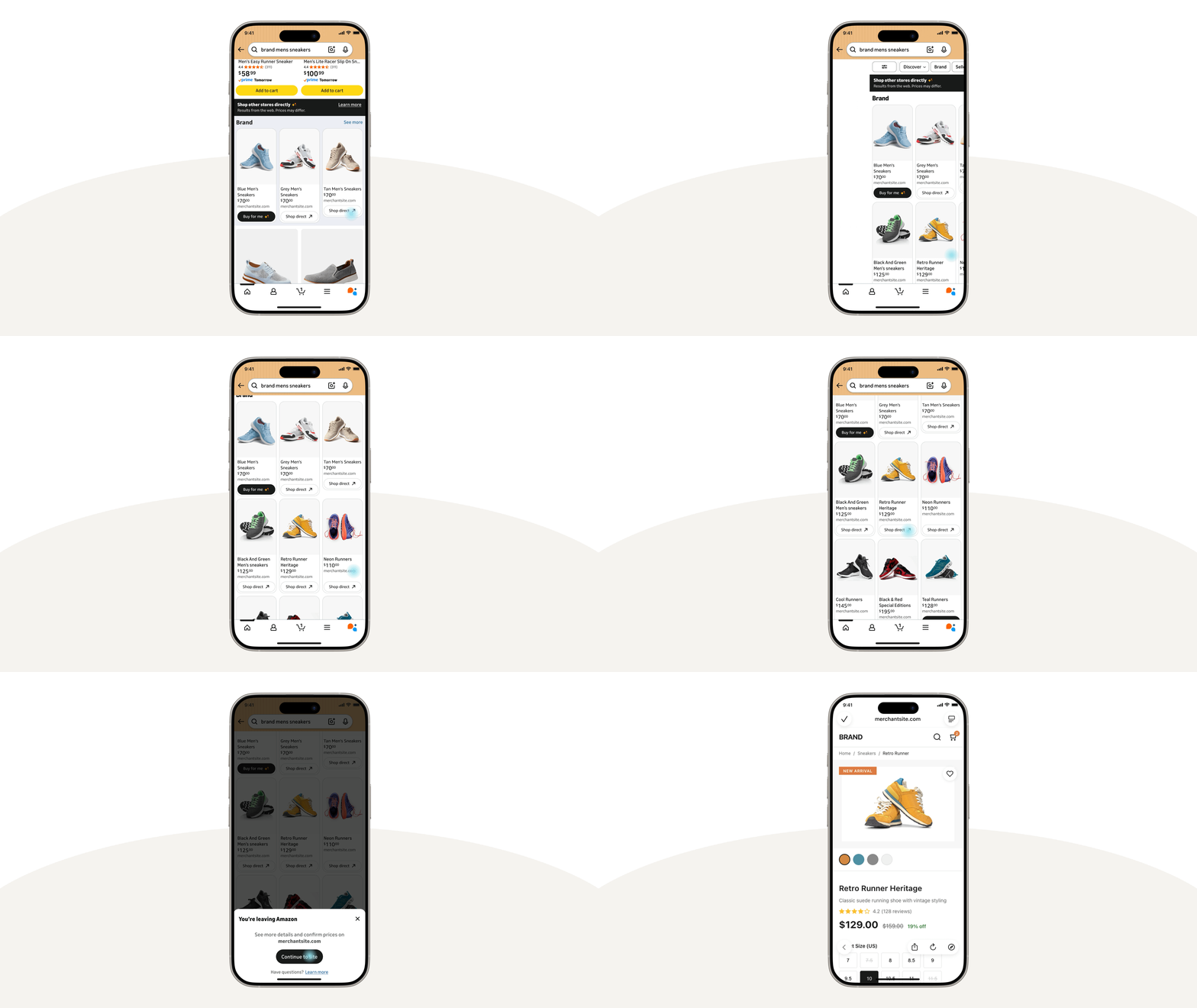
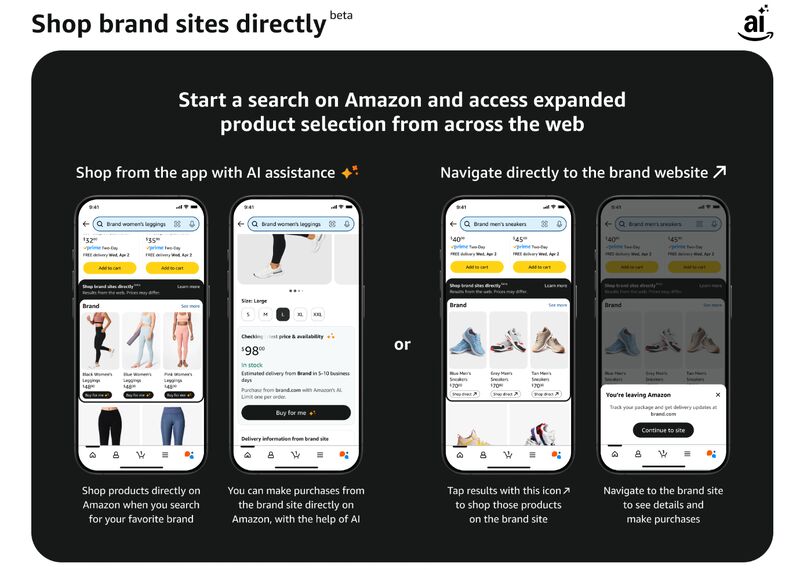
Le user journey It's easy to understand. First, the user performs a search in the Amazon app. Then, in addition to the standard marketplace results, a specific section appears: « Shop Brand Sites Directly« Or "Buy directly from the brand's website ».
When the user clicks on a product in this section, a notification informs them that they are about to leave the Amazon app. They are then redirected to the brand's website. There, they can check the price, delivery options, and complete their purchase. Amazon specifies thatNo personal data is transmitted. to the brand during this redirection.
When Amazon doesn't sell, but still directs users
The feature is primarily activated when the product is absent or unavailable on AmazonRather than leaving the user in a dead end, Amazon chooses to direct them to the brand's website.
According to Rajiv Mehta, VP of Search and Conversational Shopping at Amazon, the goal is to"To help customers find what they're looking for more easily by expanding the selection visible from the app."
In other words, Amazon prefers to guide the customer to the brand's website rather than see them go to Google.
Buy with Prime and Buy for Me: the complementary building blocks
Amazon Shop Brand Sites is not being deployed in isolation. It is part of a set of initiatives that are moving Amazon closer to the role of a shopping operating system.
| Feature | Role |
|---|---|
| Shop Brand Sites | Display branded website products in Amazon search and redirect the customer |
| Buy with Prime | Offer Prime benefits (fast delivery, returns) on purchases made on a third-party brand website |
| Buy for Me | Allowing an Amazon AI to place the order on the brand's website, via the Amazon app |
Together, these three building blocks create an Amazon that is present at every stage of the purchasing journey. regardless of the platform on which the transaction is concluded.
Why Amazon Shop Brand Sites: The Strategy Behind the Test
Behind the user experience lies a precise business logic. Amazon doesn't send its customers to third-party sites out of altruism.
Maintain control over product discovery
Amazon is the leading product search engine in the United States. However, when a user can't find what they're looking for on the marketplace, they naturally turn to Google, bringing their... purchase intentionand the associated advertising opportunities.
With Amazon Shop Brand Sites, Amazon puts a stop to this leakage. Even if the conversion takes place outside the marketplace, Amazon remains the point of contact initial. In an ecosystem where Capturing purchase intent precedes capturing the transactionThis is a decisive position.
Opening up a new arena for Amazon Ads
Amazon generated 56,2 billion advertising revenue in 2024, an 18% year-on-year increase. This makes it the third largest player in digital advertising worldwide, behind Alphabet and Meta.
This growth relies on Amazon's ability to monetize purchase intent, not just transactions. "Shop Brand Sites" represent a natural advertising space. Ultimately, Amazon could thus sell... qualified clicks to brand websites, a model that significantly expands the boundaries of its Amazon Ads offering.
Attracting DTC brands
Many DTC brands They have long resisted an Amazon presence, fearing they would lose control of their pricing, customer experience, and first-party data. For these brands, integrating with Amazon often meant accepting a volume-based approach, at the expense of profit margins and direct customer relationships.
Amazon Shop Brand Sites, on the other hand, offers a unique compromise: the brand retains its website, pricing, and customer relationships. Amazon provides visibility, traffic, and trust. This rebalancing repositions Amazon not as a restrictive partner, but as a a discovery lever that can be activated without sacrificing independence.
What Amazon Shop Brand Sites changes for brands
Having deciphered the functionality and its logic, here are the three concrete impacts for your organization.
Impact 1: The end of the "Amazon or DTC" debate
For years, management teams have asked the same question: should we sell on Amazon or invest in DTC? This dichotomy was already simplistic. With Amazon Shop Brand Sites, it becomes clearly obsolete.
Now, a brand can appear in Amazon search results without listing its entire catalog on the marketplaceIt can let Amazon capture intent and manage the conversion itself on its own site. Therefore, the real question is no longer "Amazon or DTC?" but: "What role should Amazon play in my funnel, and for which products, audiences, and objectives?"
Impact 2: The brand website once again becomes a performance asset
If Amazon starts sending high-intent traffic to your site, your site needs to be able to convert it. A user coming from Amazon arrives with high expectations, shaped by the standards of speed and seamlessness that the marketplace has standardized.
This entails several non-negotiable requirements:
| Area to be audited | Minimum requirement | Risk if neglected |
|---|---|---|
| Mobile UX | Smooth experience, fast page load times | High bounce rate |
| Product page | Clear, reassuring, aligned with Amazon | Break in experience |
| Pricing | Consistent between Amazon and the DTC site | Loss of trustworthy |
| Checkout | Frictionless, in less than 3 clicks | Shopping Cart |
| Trust | Reviews, return policy, badges | Hesitation to buy |
Furthermore, if the visuals, prices, or delivery promise differ too much between Amazon and your site, the break in experience will drive away a customer who was otherwise ready to buy.
Impact 3: New trade-offs in margin and customer lifetime value
Amazon Shop Brand Sites forces brands to engage in an exercise that is often avoided: arbitrating channel by channel, product by product.
Some SKUs are destined to remain on Amazon, particularly those where volume, visibility, and logistics create value that is difficult to replicate in direct-to-consumer (DTC) sales. Others, however, are better served by the brand's own website: high-margin products, products with high repeat purchase potential, or products with high customer relationship value.
Indeed, it is on these products that building a direct link with the buyer represents a sustainable competitive advantage, one that translates into LTV, first-party data and independence from platforms.
The question strategic therefore no longer needs to be put forward to the management committee "What percentage of our revenue comes from Amazon?" This is : "For each catalog segment, which channel maximizes margin, customer lifetime value, and relationship control?"
Amazon Shop Brand Sites: 3 Scenarios for 2026–2027
Amazon Shop Brand Sites remains in beta testing today. Nevertheless, the signals it's sending suggest three plausible scenarios for the coming months.
Scenario 1: trivialization of direct access to brand websites
Amazon has indicated that it wants expand functionality to more users and brands, depending on the feedback received. If this rollout is successful, seeing a "Buy on the brand's website" link on Amazon would become as natural as a Sponsored Product is today.
Thus, brands that have anticipated the preparation of their site, their offer and their organization will gain a decisive advantage over those that wait for the functionality to be widespread before reacting.
Scenario 2: Increased monetization via Amazon Ads
The Amazon Shop Brand Sites blocks in search results represent a natural advertising space. It's likely that Amazon will develop other formats. sponsored associatesallowing brands to enhance their visibility in these spaces.
Therefore, retail media on Amazon would no longer be used solely for selling in the marketplace, but also for purchase qualified intent from the DTC siteFor media teams, this means anticipating this paradigm shift in their 2026–2027 plans.
Scenario 3: New lever or new dependency?
This is the most nuanced scenario, and the most important to anticipate. If Amazon Shop Brand Sites becomes a significant source of DTC traffic, dependence on Amazon will mechanically increase. A change in algorithm or policy could then directly impact a brand's acquisition performance.
Hence the importance of clear internal governance: Who "owns" this traffic within your organization? How can we manage this lever so that it remains an accelerator, and not a point of strategic weakness?
Conclusion: Amazon is changing its role — your strategy must follow suit
Amazon Shop Brand Sites is not just a technical test. It signals a long-term ambition: to remain at the heart of every shopping journey, even when the transaction takes place outside the marketplace.
For brands, three priorities clearly emerge. First, move beyond the "Amazon vs. DTC" dichotomy and think in terms of channel orchestration. Second, treat the brand website as a performance asset in its own right. Third, make strategic decisions based on product, margin, and customer value objectives, using a coherent and managed approach.
Finally, and most importantly: don't wait for the feature to become widespread. The brands that win are those that anticipate.
Is your brand ready for Amazon Shop Brand Sites? Wilift supports brand founders, CMOs, and e-commerce managers to clarify their Amazon × DTC strategy and prepare their digital assets to capture this new traffic.
Contact us for an Amazon × DTC Readiness diagnosis.
Recent Comments