
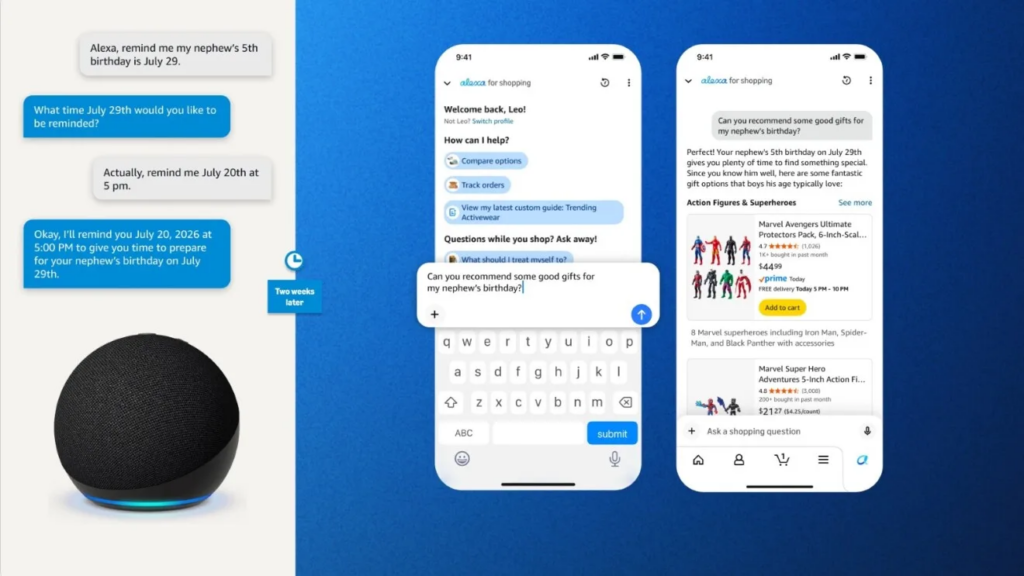
Amazon Rufus already recommends products to over 250 million shoppers, and sellers who have adapted their catalogs to this new approach are seeing conversion increases of 12% to 18%. However, most catalogs are still structured for traditional SEO, while AI shopping assistants no longer read a product page like a conventional search engine. This guide details, step by step, how to make a catalog truly readable, understandable, and recommended by these new shopping assistants.
Why AI shopping agents are a game changer for retailers
From Rufus to Alexa for Shopping: what changed in 2026
In May 2026, Amazon merged Rufus into a new interface called Alexa for Shopping, capable not only of answering shoppers' questions but also of acting on their behalf. This name change, however, does not alter the fundamentals of catalog optimization. Indeed, the principles of structured data, conversational content, and social proof remain the same; only the interface evolves. It therefore remains essential to continue optimizing for AI shopping agents, regardless of the assistant's name at any given time.
An AI agent doesn't read a record like a human; it parses data.
A human shopper visually scans a product page and fills in the missing information intuitively. An AI agent, on the other hand, extracts structured data and specific text blocks to construct its response. Consequently, any implicit or implied information remains invisible to the algorithm, even if it seems obvious to a human reader.
What this means for a poorly prepared catalogue
A product listing can appear normally on Amazon, receive organic traffic, and convert well with human shoppers, yet remain completely absent from recommendations made by AI shopping agents. This discrepancy is currently one of the most frequent blind spots for sellers, who continue to measure their performance solely through traditional metrics.
How AI shopping agents actually evaluate a product
The concept of semantic trust
AI-powered shopping agents evaluate a product through what can be called semantic trust. They combine available structured data, associated multimedia content, and the user's expressed purchase intent. A product thus becomes recommendable not because it contains the right keywords, but because all of its signals converge toward a clear and verifiable answer.
Difference with traditional keyword-based SEO
Traditional SEO relies on matching a search query with keywords present in the title or description. AI agents work differently, as they primarily aim to answer a complete question, often formulated in natural language. Therefore, a listing optimized solely for isolated keywords lacks the argumentative structure expected by artificial intelligence.
Why a well-ranked product page using traditional SEO can remain invisible
It's not uncommon for a listing that ranks highly in Amazon search results to receive disappointing results from AI-powered shopping algorithms. Indeed, good keyword optimization doesn't guarantee the presence of complete structured data, nor does it guarantee content detailed enough to answer shoppers' implicit questions. These two evaluation systems should therefore be considered complementary, but decidedly distinct.
Structured data: the non-negotiable basis for attracting AI shopping agents
The minimum pattern to be covered for each product
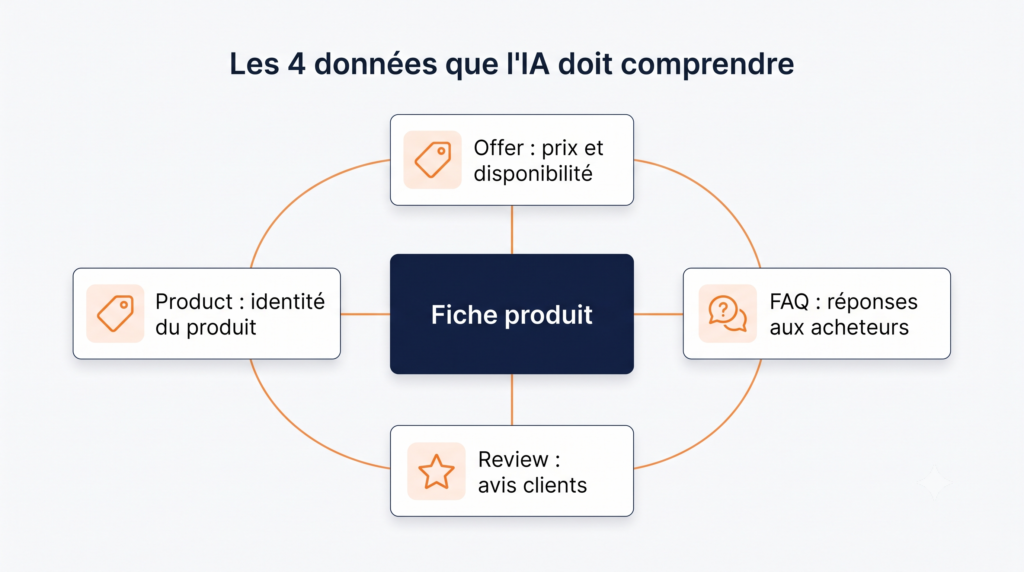
A catalog ready for AI shopping agents must cover at least four types of structured data, summarized in the following table.
| Data type | Role for the AI agent |
|---|---|
| Product | Product identity: name, category, brand, identifiers |
| Offer | Price, availability, terms of sale |
| Review | Social proof and aggregated feedback |
| FAQ | Direct answers to frequently asked questions from buyers |
Essential attributes that should never be left blank
Among attributes The most important factors include the full product name, a detailed description, the brand, the SKU, the GTIN, the price, stock availability, and the average aggregate rating. Each of these elements contributes directly to the semantic confidence mentioned earlier, and their absence weakens the AI's ability to recommend the product.
Why a missing attribute is equivalent to an invisible product
Unlike a human, who can infer missing information from visual context, an AI agent never fills in that gap. An absent attribute therefore doesn't simply represent incomplete data, but a genuine breaking point in the chain of semantic trust. Thus, a product with high buyer ratings can still disappear entirely from AI recommendations.
Rewrite your content to interact with AI shopping agents
Transforming classic bullet points into answers to real questions
Traditional bullet points, often written as simple marketing arguments, must now be thought of as direct answers to concrete questions that buyers ask themselves. An effective chip starts by anticipating a specific question, then answers it completely and verifiably.
Write a description that covers uses, contexts, and objections.
A high-performing product description for AI shopping agents typically exceeds 300 words. It consistently covers key uses, various usage contexts, and common objections from potential buyers. This wealth of content allows the AI to formulate a relevant response, regardless of how the initial question was phrased.
A concrete example to illustrate this logic
Let's take a versatile kitchen accessory. An incomplete description will only mention its main function. A description designed for AI, on the other hand, will specify every possible use, such as cutting meat, vegetables, or cheese, as well as its potential role in presenting a dish. This comprehensiveness prevents the AI from having to interpret the information, and therefore avoids the risk of an inaccurate response.
The audit method for questioning AI shopping agents like a customer
The 5 questions to systematically ask on your own profile
Before any optimization, it is recommended to tests directly access their file by asking the following questions to the relevant AI agent.
- What exactly is this product used for?
- What do customers appreciate the most?
- What do customers like the least?
- What do buyers usually replace this product with?
- Why choose this product over a similar competitor?
What each response reveals about the shortcomings of the current content
A vague or generic answer to any of these questions usually indicates a specific gap in the listing's content. An imprecise answer to the first question often reveals an insufficiently explicit title, while a poor response to questions about customer preferences signals a lack of use of existing reviews.
Transforming these answers into a concrete action plan
Each identified gap must then be directly linked to a corrective action on the document, such as enriching the title, adding a FAQ section, or rewording the bullet points. This method thus transforms a qualitative audit into an operational roadmap, without requiring complex technical tools.
Images and visual search: what AI shopping agents need to understand
Test your main visuals by submitting them to an AI tool
A simple method involves submitting a product's main image to an artificial intelligence tool and directly asking it what it perceives. If the response differs from the product's actual use, this indicates a risk of misinterpretation, with direct consequences for the relevance of the recommendations made.
Why an ambiguous product needs to include clarifying text or packaging
When visual ambiguity persists despite several attempts at clarification, it becomes relevant to integrate a text element or distinctive packaging directly onto the image. approach reduces the risk of misinterpretation, without relying solely on the visual recognition quality of the AI agent used.
The role of secondary visuals in understanding the context
Secondary images play a crucial complementary role, as they demonstrate a concrete use case, a scale of size, or a realistic context of use. These visual elements thus reinforce the overall semantic confidence of the product sheet, directly complementing the already optimized text content.
Measuring its actual visibility to AI shopping agents
Measurement method: category-level prompts and mention rate
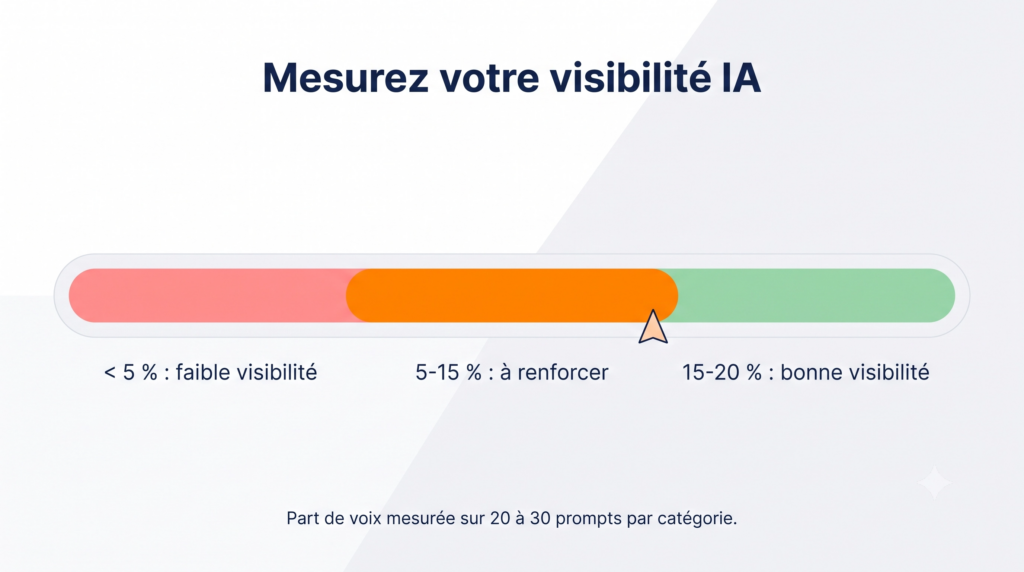
To objectively assess its visibility, 20 to 30 prompts representative of a product category should be submitted to an AI agent, and the proportion of responses actually mentioning the brand in question should be calculated. This rate provides a direct indicator of the share of voice obtained within the generated recommendations.
Reference thresholds for interpreting its level of visibility
Un mention rate A visibility rate between 15% and 20% is generally considered satisfactory, while a rate below 5% indicates a serious lack of visibility requiring prompt corrective action. These thresholds thus allow for prioritizing the product categories to be optimized first.
Why test across multiple accounts and geographic areas?
Results obtained from an AI agent can vary significantly depending on the account used, browsing history, or geographic area tested. Therefore, it is recommended to repeat this measurement across multiple accounts and distinct areas to obtain a reliable estimate rather than a result biased by AI personalization.
The continuous improvement loop to remain visible to AI shopping agents
Verify the accuracy of the information returned by the AI
It is not enough to verify its presence in the recommendations, because it is also necessary to ensure that the information retrieved AI-generated results remain accurate, particularly regarding price, technical specifications, and stock availability. Even a minor error can be enough to jeopardize a potential conversion.
Correct systematically at the source
Every identified error or gap must be corrected directly at the source, whether it's the product page itself, the associated enriched content, or the management of customer reviews. This discipline ensures that corrections benefit all discovery channels, not just a specific AI agent.
Implement monthly monitoring across multiple AI agents
Finally, regular monthly monitoring should be implemented on the main AI shopping agents available, testing the most frequently asked product questions from shoppers. This continuous monitoring allows for anticipating algorithmic changes, such as the recent switch between Rufus and Alexa for Shopping, without experiencing a sudden and unexplained loss of visibility.
Conclusion: Make your catalog a lasting advantage against AI shopping agents
Un optimized catalog What is automatically optimized for humans is no longer automatically optimized for artificial intelligence. The two logics now coexist, and only a structured, conversational, and measured approach allows you to remain visible across all product discovery channels, both current and future.
To begin this process this week, it's advisable to verify the completeness of the structured attributes on your flagship products, then ask the five audit questions directly on your most strategic product pages. It's also helpful to measure your current mention rate in a priority category before addressing the most visible gaps.
Is your catalogue actually readable by AI shopping agents?
The WILIFT team offers an AI visibility audit of your product catalog, in order to precisely identify the gaps to correct before they impact your share of voice on these new discovery channels.
Book your audit starting today to anticipate this transition rather than being subjected to it.
Recent Comments