
Why do brands need a multichannel strategy (Amazon + D2C website) for sustainable growth? Amazon D2C omnichannel strategy It is no longer an option for brand founders. It is becoming a strategic necessity.
Today, Amazon represents a major share of global e-commerce. According to The report of StatistaMarketplaces concentrate more 60% of global e-commerce salesHowever, at the same time, brands are investing heavily in their D2C websites in order to collect customer data and protect their margins.
This paradox creates a tension: Should we depend on Amazon to grow rapidly?
Or should the priority be investing in one's own website?
In reality, pitting the two channels against each other is a mistake. Amazon D2C omnichannel strategy This allows you to leverage the power of Amazon while building a lasting asset through the website. This long-term vision aligns with the mindset of a founder who wants to build a brand, not just generate revenue.
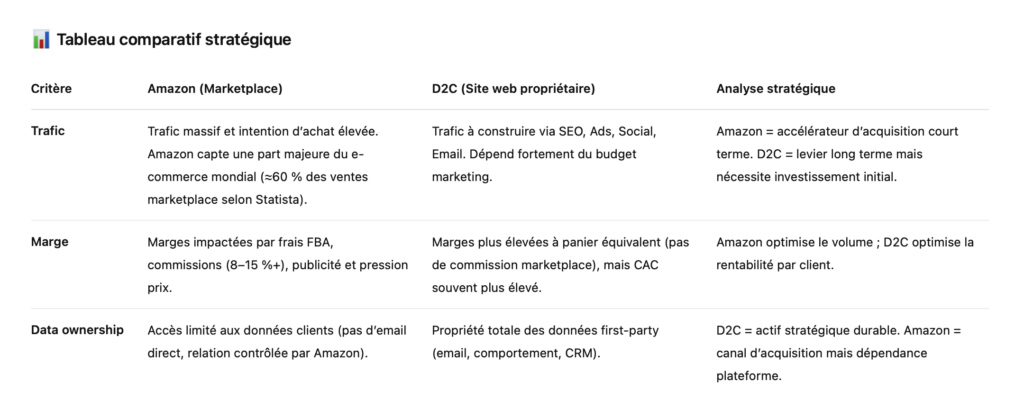
Amazon as leverage, website as an asset (Owned Media)
Amazon acts as an accelerator. The website acts as a strategic asset. On the one hand, Amazon offers immediate access to massive, qualified traffic. Consumers arrive with a strong purchase intent. Consequently, the conversion rate is often higher than that of a fledgling D2C site. Furthermore, FBA logistics simplifies international expansion.
However, Amazon limits access to customer data. You have no control over email or direct customer relationships. Furthermore, FBA fees, advertising costs, and algorithm changes can reduce your margins.
Conversely, a D2C website requires a larger marketing investment. Acquisition costs are higher. However, it offers a decisive advantage: data ownership. According to Shopify, email marketing generates an average return of $36 to $42 for every dollar invested. This lever significantly improves the Customer lifetime value (LTV).
Thus, in a Amazon D2C omnichannel strategyAmazon generates volume, while the website builds long-term value.
Logistics challenge: Synchronizing stock levels between the website and FBA (Multi-Channel Fulfillment)
Multichannel growth presents a major operational challenge: inventory synchronization. If you sell on Amazon and your own website, you must avoid two risks: stockouts and excessive cash tied up. Without synchronization, you lose sales or block your cash flow.
Fortunately, Amazon offers the Multi-Channel Fulfillment (MCF). This system allows the use of FBA stocks to ship orders from your website. This way, you centralize logistics.
However, this solution requires a clear understanding of the flows. You need to analyze:
- Sales distribution by channel.
- the rotation product,
- restocking times,
- seasonality,
According to Deloitte, brands that unify their inventory management significantly reduce disruptions and improve their operational profitability.
So, one Amazon D2C omnichannel strategy It doesn't rely solely on marketing. It requires a robust logistics architecture.
Customer loyalty: Where to collect the data?
Customer loyalty is the true driver of sustainable growth. On Amazon, you benefit from the platform's trust. However, Amazon controls the customer relationship. You cannot freely use emails or implement personalized loyalty programs.
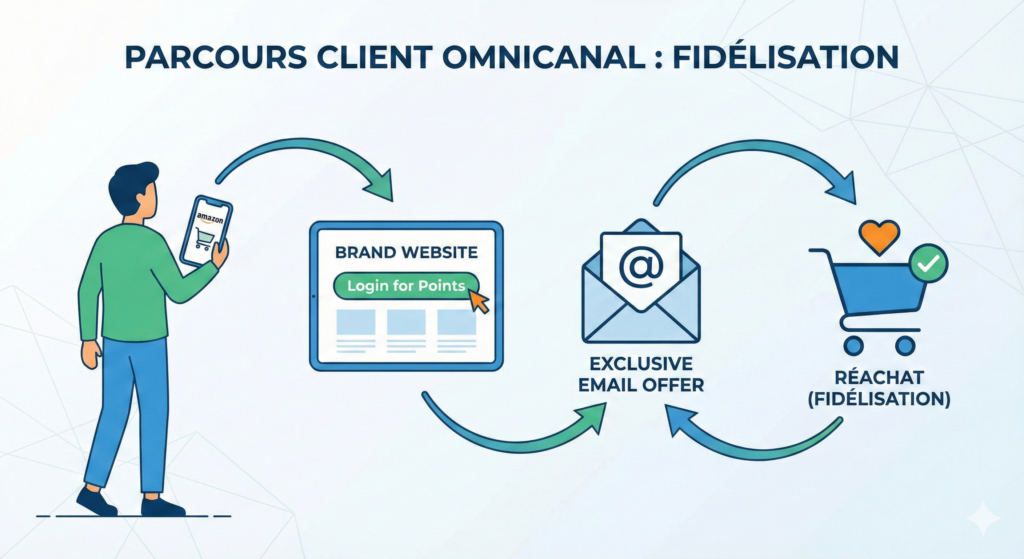
On your D2C site, however, you collect first-party data: emails, purchasing behavior, order frequency. This information allows you to build retargeting scenarios, exclusive offers, and upsell strategies.
According to McKinsey & Company, the omnichannel customers show a value 30 to 40% higher compared to single-channel customers. This means that combining Amazon and D2C increases the LTV potential.
Thus, Amazon can serve as an acquisition tool. Then, the website becomes the loyalty channel. In a Amazon D2C omnichannel strategyYou attract customers via the marketplace, then you develop the relationship via your proprietary ecosystem.
Case study: Traffic synergy between the two platforms
Imagine a brand launching a new product. It activates Amazon Ads to capture existing demand. Sales take off quickly thanks to marketplace visibility. At the same time, it invests in social media content and email campaigns driving traffic to its website.
Gradually, she observes that:
- Amazon generates immediate volume.
- The website improves the profit margin per order.
- Most repeat customers come from D2C.
This hybrid model reduces strategic risk. If Amazon changes its rules, the brand retains its proprietary channel. If the cost of D2C acquisition increases, Amazon continues to generate revenue.

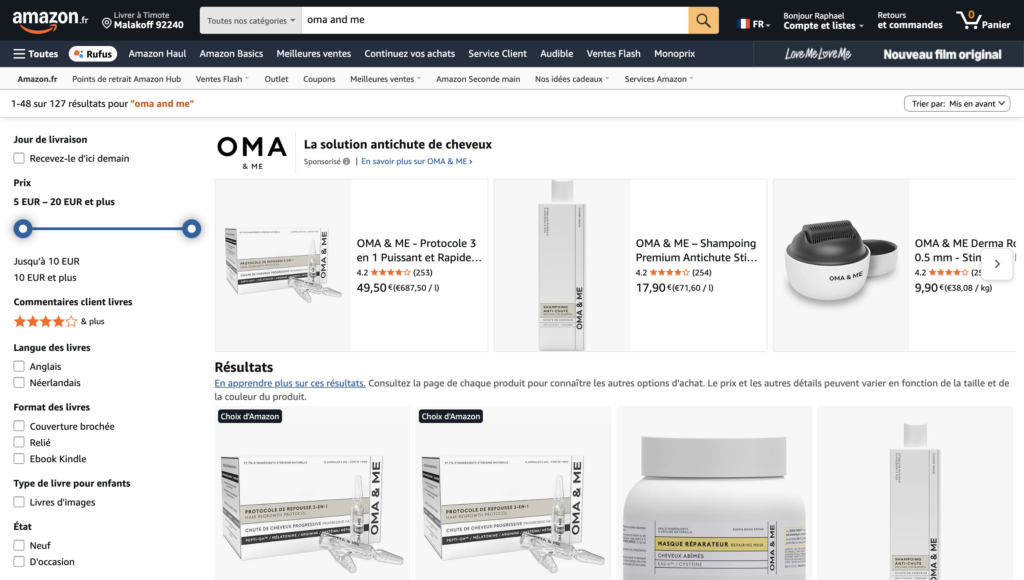
This complementarity illustrates the power of a Amazon D2C omnichannel strategy.
Strategic solutions for founders
To implement an effective strategy, a founder must:
- Define the precise role of each channel.
- Centralize inventory management.
- Implementing a robust CRM for D2C.
- Measure profitability separately by channel.
- Drive overall LTV rather than isolated revenue.
Next, it must align marketing, finance, and logistics around a common vision. This coherence creates a sustainable competitive advantage.
A brand that relies solely on Amazon builds a fragile revenue stream. A brand that focuses solely on D2C often slows its growth. On the other hand, a Amazon D2C omnichannel strategy It combines acquisition power, data control, and margin optimization. It's a founder's vision, a logic oflong-term asset.
At WiliftWe support brands that want to structure their growth between Amazon and their website.
Want to know if your current architecture is truly optimized? Request a multichannel strategic audit. We analyze your margins, logistics, and customer loyalty potential.
Recent Comments