
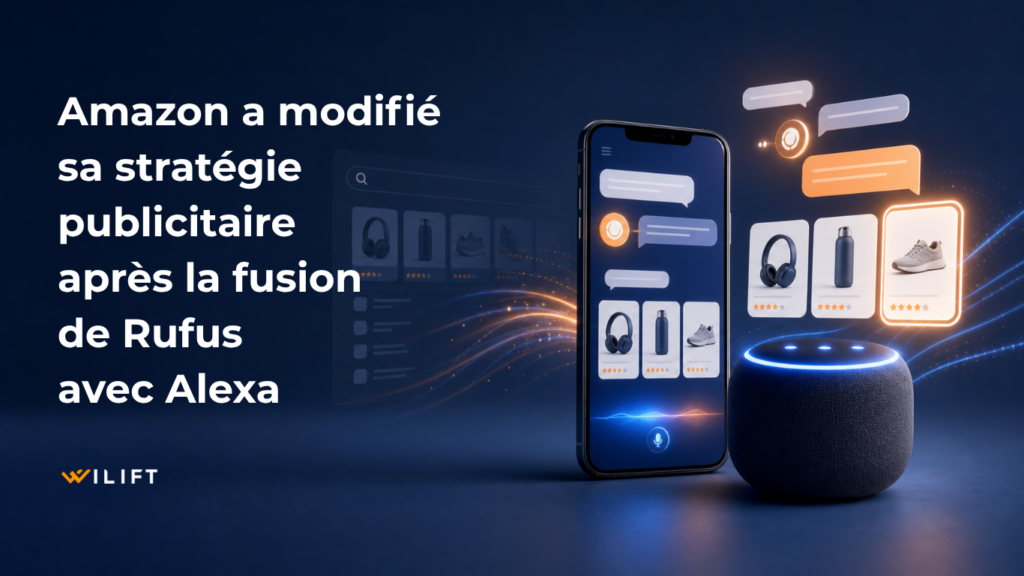
On May 13, 2026, Amazon quietly retired Rufus after it had over 300 million users, in order to merge its entire ecosystem. product intelligence in a new experience called Alexa for Shopping. This change goes far beyond a simple technical update, as it directly redefines Amazon Rufus Alexa advertising, since the search bar itself now becomes a interface AI-powered conversational interface.
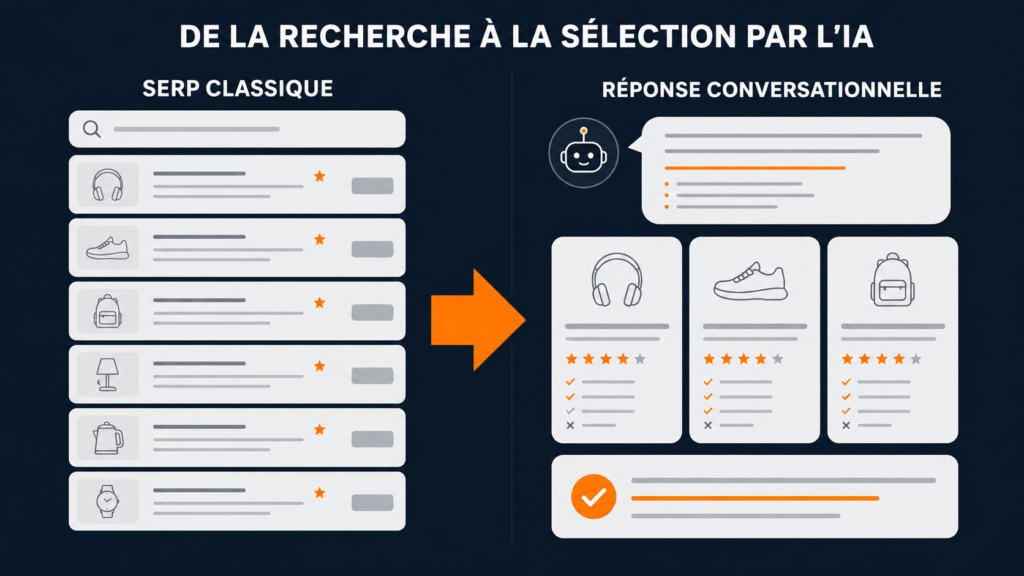
For several years, gaining visibility on Amazon meant occupying top positions in a traditional SERP, structured around keywords and advertising bids. With Alexa for Shopping, however, a growing portion of the demand is now resolved directly in a conversational response, before the user even consults a traditional list of results. This article details what this means in concrete terms for Sponsored Ads and presents the new features. advertising formats born from this merger, then identifies the signals that today determine the selection of a brand by Amazon's artificial intelligence.
Amazon Rufus Alexa advertising: what has really changed
Why Amazon withdrew Rufus after 300 million users
Rufus had amassed a considerable user base since its launch, with over 300 million shoppers interacting with the chatbot. However, Amazon made the strategic decision to retire the Rufus brand on May 13, 2026, not to abandon this intelligence, but to... merge directly into Alexa, its long-standing voice assistant.
This choice stems from a clear logic of unifying the customer experience. Rather than maintaining two separate artificial intelligence systems, one dedicated to product search and the other to the voice assistant, Amazon preferred to concentrate all its shopping intelligence into a single agent. This agent unique now operates both in the search bar and on Echo devices, allowing Amazon to capitalize on a single product memory and a single purchase history.
How does Alexa for Shopping work in the search bar?
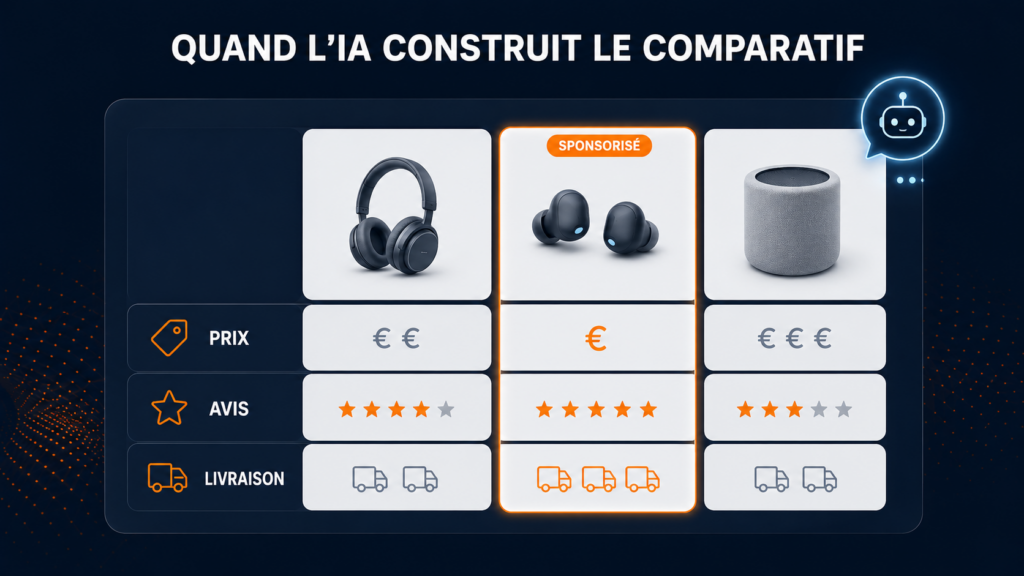
In practice, when a user enters a query in the Amazon search bar, it is now analyzed by Alexa for Shopping, which generates a rich response combining several elements simultaneously. This response includes a conversational summary, a comparison table between several products, and a price history that can go back up to one year.
The traditional results list hasn't disappeared, but it's no longer the sole point of contact between the customer and available products. Alexa for Shopping therefore adds an extra layer of interpretation, positioned before the traditional catalog browsing.
From classic SERP to conversational response
This transformation represents a structural shift rather than a mere cosmetic change. Previously, a customer would type in a keyword, browse a list of results, visually compare several product descriptions, and then make their choice independently. Now, the agent intervenes upstream in this decision-making process, personally selecting a limited number of products to feature.
Therefore, being featured in this selection becomes a strategic imperative at least as important as the position held on the traditional SERP. It is precisely this shift that necessitates a complete overhaul of the Amazon Rufus Alexa advertising strategy for any brand selling on the platform.
Are Sponsored Ads still effective on Alexa for Shopping?
Are your current campaigns automatically eligible?
Amazon Ads has confirmed that existing Sponsored Ads campaigns remain eligible to appear within Alexa for Shopping, without requiring the creation of new dedicated campaigns. continuity This technique logically reassures advertisers, since no forced migration is required in the short term.
This automatic eligibility, however, does not guarantee automatic visibility. Indeed, the way the algorithm selects products to include in a conversational response differs significantly from the logic of a traditional SERP ranking. A technically eligible campaign can therefore remain invisible if the underlying qualitative signals are not sufficiently strong.
Sponsored Products and Sponsored Brands prompts
Amazon has introduced a new format called Sponsored Products and Sponsored Brands prompts, designed specifically to integrate into shopping results and product pages in a conversational way. This format literally allows you to start a conversation with Alexa for Shopping directly from an advertisement, the agent then acts as a virtual product advisor.
This approach fundamentally transforms the role of advertising itself, as it is no longer limited to capturing a click. Instead, it becomes an entry point to an in-depth dialogue between the customer and artificial intelligence, a dialogue in which the brand can continue to be promoted if its product data is sufficiently rich.
The role of auctions in Alexa-generated comparisons
When Alexa for Shopping creates a comparison chart between multiple products, the question of which ASINs are included becomes crucial. Although Amazon hasn't published a detailed methodology on this specific point, several industry analysts believe that sponsored auctions are likely one of the signals influencing this selection, alongside traditional organic criteria.
Therefore, a competitive bid on strategic keywords in your category is no longer just about gaining a position on the SERP. It also potentially helps secure a place in the comparison that artificial intelligence presents directly to the end customer.
The new formats born from the Rufus-Alexa merger
Alexa+ Agentic Ads: Buy without leaving the conversation
Amazon launched Alexa+ Agentic AdsThis advertising format allows customers to go from simply viewing an ad to making a full purchase, without ever leaving the conversation with the assistant. This format is currently being tested in beta on Echo Show devices, with partners such as Papa Johns for food ordering and Ticketmaster for concert ticket purchases.
This type of advertising perfectly illustrates the nature agentic of this new generation of shopping. The user expresses a need, the agent proposes a personalized solution, and the transaction is completed immediately, without redirection to a separate website or payment page.

Conversational Display Ads: Advertising is leaving Amazon
Since June 22, 2026, Amazon has also extended this conversational format beyond its own ecosystem, deploying it on the open web via the Conversational Display AdsIn practical terms, an advertising banner displayed on a third-party site can now contain clickable questions that directly open a conversation with Alexa for Shopping.
This extension marks an important step in Amazon's advertising strategy, as it allows the brand to capture the attention of a potential customer long before they enter the Amazon platform itself.
Why 70% of orders come from new customers
The initial performance data for this new format is particularly revealing. Approximately 20% of users exposed to these banners actually continue the conversation initiated with Alexa. Furthermore, 70% of the orders generated come from customers who had never previously purchased from the brand in question.
This figure suggests that Conversational Display Ads could quickly become a powerful acquisition lever for brands looking to expand their customer base, rather than simply a retention tool for an already acquired audience.
The signals that determine Alexa's selection
A catalogue designed to be understood by artificial intelligence
For a brand to be correctly identified and recommended by Alexa for Shopping, the quality and structure of product data become absolutely essential. Unlike a keyword-based search engine, the agent must understand the context of use, the target audience, and the distinctive characteristics of a product in order to suggest it in response to a complex query.
Thus, titles, bullet points, and technical attributes must now be written with explicit consideration of how artificial intelligence interprets natural language, rather than focusing solely on the keyword density sought by traditional search engines.
Customer reviews and logistics remain fundamental
Despite this technological transformation, some fundamentals remain unchanged. The density, freshness, and consistency of customer reviews continue to play a decisive role in how Alexa assesses a product's reliability. Similarly, logistical performance, including stock availability and delivery times, remains a key criterion.
Therefore, no Amazon Rufus Alexa advertising strategy can sustainably compensate for a weakness in these operational fundamentals, regardless of the advertising budget invested by the brand.
The price, now visible in automated comparison tools
Finally, when Alexa for Shopping generates a comparison chart between several similar products, price positioning becomes immediately visible to the customer, much more directly than on a traditional SERP. This increased transparency thus compels brands to maintain a consistent and competitive pricing policy, without sacrificing their long-term positioning.
Adapt your strategy according to your brand profile
Challenger brands: include them on the agent's shortlist
Challenger brands, which generally have a more limited sales and review history than established players, face a specific challenge in this new environment. Some retail media experts point out that if Alexa prioritizes historical and volume-based reviews, acquiring new customers could become more difficult for emerging brands.
To counter this dynamic, these brands must prioritize investing in the quality of their customer reviews, as well as in rich educational content, capable of clearly demonstrating their added value compared to competitors better established in the market.
Leading brands: protecting their conversational position
Conversely, brands already well-positioned must now ensure they protect their visibility within Alexa's conversational responses, rather than solely in traditional SERP positions. This requires continuous monitoring of how the agent presents and compares their products against direct competitors.
Two approaches depending on the level of product involvement
The strategy to adopt also varies depending on the level of involvement associated with the product sold. For high-involvement products, such as electronics, Alexa for Shopping offers detailed buying guides, which requires brands to provide particularly comprehensive data.
Conversely, for low-involvement, repeat-purchase products, agentic features like automatic repurchase can quickly lock in customer loyalty around the brand that has optimized their first purchase experience.
Measuring performance in an agentic world
Why is clicking alone no longer enough?
Amazon has explicitly acknowledged that a growing proportion of demand is now resolved directly within the response generated by the agent, rather than via a click redirecting to a landing page. This shift renders traditional metrics, such as the isolated click-through rate, insufficient for accurately assessing the true effectiveness of an advertising campaign.
The new conversational indicators
Faced with this limitation, new indicators must gradually be incorporated into advertisers' dashboards. These include the conversation initiation rate, the rate of continued interaction with the agent, and the purchase completion rate directly from the conversation.
Cross-referencing Amazon Ads data and customer acquisition
Furthermore, certain conversational formats generate a high proportion of new customers, as observed with Conversational Display Ads. It is therefore essential to cross-reference data from Amazon Ads with specific customer acquisition metrics to measure the true contribution of each agentic format.
Prepare for the next 12 to 24 months
The tension between customer trust and advertising revenue
One structural issue deserves particular attention. Some analysts point to an inherent tension in Amazon's business model: if the platform excessively favors sponsored products, user trust could gradually erode. Conversely, if the platform prioritizes organic results exclusively, Amazon's advertising revenue, which reached $56 billion in 2025, could be directly threatened.
Immediate action checklist for your brand
To secure your position in the long term, here are the priority actions to take without delay:
- Audit the current structuring of product data, explicitly considering its readability through conversational artificial intelligence.
- Strengthen the customer review strategy, ensuring that reviews are fresh and consistent with the claims on the product page.
- Test the new Sponsored Products and Sponsored Brands formats quickly on a limited scale before a wider rollout.
- Implement a monitoring system for conversational indicators, in addition to the traditional advertising indicators already in use.
- Define a clear internal governance structure to guide your brand's participation in emerging agentic advertising formats.
Conclusion: From position buying to conversational selection
The merger of Rufus into Alexa for Shopping doesn't mark the end of Amazon Rufus Alexa advertising, but it fundamentally transforms the logic behind gaining visibility on the platform. Where advertising strategy previously relied on purchasing a ranking position, it now also depends on a brand's ability to be selected by a chatbot at the precise moment it's crafting its response for the customer.
This shift therefore requires advertisers to simultaneously rethink the quality of their product data, the structure of their campaigns, and the metrics used to measure their actual performance. Brands that can adapt quickly to this new conversational reality will have a lasting competitive advantage, at a time when most market players are only just beginning to grasp its implications.
Is your Amazon advertising strategy ready for the agentic age?
Let's discuss your current catalogue and ongoing campaigns, in order to jointly identify the priority adjustments to be made before this window of opportunity closes.
Recent Comments