
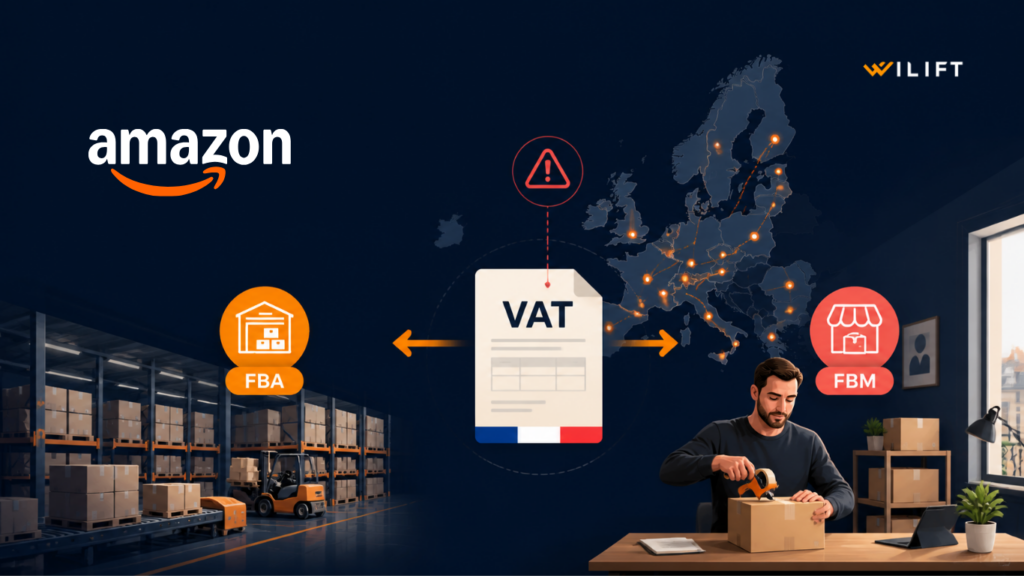
La Amazon FBA VAT This is often the first source of confusion for a seller new to Amazon. Many believe that the platform automatically handles this requirement as soon as they activate the program. Shipped by AmazonOthers, conversely, believe that the FBM completely exempts them from this constraint because they manage their own logistics. Both of these beliefs are, however, erroneous, and they can lead to inventory freezes, account suspensions, or tax audits.
In reality, Amazon FBA France VAT is primarily determined by the location where the products are physically stored, the country of the end customers, and the sales volume generated internationally. This three-pronged approach is far more important than simply choosing between FBA and FBM. That's why this article precisely compares the tax risks associated with each model, to help any new seller structure their business on a solid foundation from the outset.
Understanding Amazon FBA VAT: What a beginner seller needs to know
VAT does not depend solely on turnover
Contrary to popular belief, VAT liability on Amazon is not solely based on a revenue threshold. Amazon states that three factors determine this obligation: the company's country of establishment, the location where products are stored, and the sales volume. Therefore, a seller who does not exceed any threshold can still become immediately liable for local VAT simply because they store products in a given country.
In France, the basic VAT exemption threshold is €85,000 in annual turnover, with a tolerance of up to €93,500. Above this threshold, VAT registration becomes mandatory for domestic sales in France. However, this threshold only applies to sales made within France; it therefore does not protect a seller who begins storing their products elsewhere in Europe.
The three factors that trigger a VAT obligation
Before choosing between FBA and FBM, three specific questions need to be answered. First, where are the products physically stored? Second, in which country do the customers involved in the sale reside? Third, who, between the seller and the marketplace, is responsible for collecting and remitting the VAT on this transaction?
These three questions underpin all the obligations related to Amazon FBA VAT. They also explain why two sellers with identical revenue can end up with completely different tax obligations depending on their logistics organization.
Why Amazon's VAT collection is not enough
In certain specific cases, Amazon acts as a presumptive supplier for VAT purposes, particularly when a seller not established in the European Union makes sales of goods imported of low value. Amazon then collects the VAT due and pays it directly, without any intervention from the seller in this specific transaction.
However, this mechanism does not cover all of the seller's tax obligations. Even when Amazon assumes this role for certain sales, the seller remains responsible for registering in the countries where they store their products, as well as filing their local tax returns. Confusing these two levels of responsibility remains one of the most common mistakes made by novice sellers.
FBA and FBM: two logistical approaches with different tax consequences
How FBA works on Amazon
With FBA, the seller ships their inventory to one or more Amazon warehouses. The platform then handles storage, order fulfillment, delivery to the end customer, and returns management. Depending on the activated program—national, European, or Pan-European—products may remain in a single country or be automatically distributed across multiple fulfillment centers to expedite delivery times.
It is precisely this automatic allocation that makes FBA more sensitive from a tax perspective. The crucial question, therefore, is not whether Amazon delivers correctly to customers, but rather in which countries the stock is actually located at any given time.
How FBM works on Amazon
With FBM, the seller, or a logistics provider of their choice, handles the storage and shipping of orders themselves. This allows them to retain control over the location of their stock, packaging, and returns management. However, this increased control does not eliminate all tax risks: as soon as a third-party warehouse is located in another European country, this location creates the same local VAT obligations as an Amazon warehouse.
The difference that changes everything: the storage location
Ultimately, the key distinction between FBA and FBM lies not in who ships the order, but in who truly controls the location of the inventory. With FBA, Amazon can decide to distribute products across multiple countries without the seller always having immediate visibility. With FBM, the seller generally retains this control, except when they outsource their logistics abroad.
Amazon FBA France VAT: when does registration become mandatory?
The principle of storage that triggers the obligation
The core rule of FBA remains simple and has no notable exceptions. As soon as products are physically stored in an Amazon warehouse located in a European Union country, a registration VAT registration becomes mandatory in this country, regardless of turnover. For a foreign seller storing goods in France via Amazon FBA, this means mandatory registration from the very first product stored, with no exceptions.
This rule applies equally to a seller established outside the European Union and to a seller established in another member state. The mere act of storing goods creates what many tax experts consider a fixed establishment for VAT purposes, thus triggering an immediate obligation.
The Pan-European FBA program and the proliferation of countries
The Pan-European FBA program allows Amazon to automatically distribute a seller's inventory across multiple countries, such as Germany, France, Italy, Spain, and Poland, to expedite Prime deliveries throughout Europe. While the logistical advantage remains significant, the tax implications are equally substantial: a valid VAT number is required in each country where the inventory is physically located.
The eligibility criteria have also recently changed. Amazon now requires a minimum of five active VAT numbers in European countries to participate in the Pan-European program. A seller who activates this option without having anticipated these multiple registrations risks having their inventory blocked in the countries concerned.
Amazon's presumed supplier status
For certain transactions involving sellers not established in the European Union, Amazon may assume the role of presumed supplier and directly collect the VAT due at the time of sale. mechanism It reduces part of the collection burden for these specific transactions, but in no way does it exempt the seller from registering in each FBA storage country, nor from filing the corresponding local declarations, including for tracking intra-community stock movements.
Amazon FBM VAT: What are the obligations for a seller who ships their own orders?
FBM from a single country, simpler management
When a seller uses FBM from a single country, such as France, and ships all their orders themselves, the tax situation remains significantly simpler to manage than with a multi-country FBA. The required registration is then, in principle, limited to the country of storage, while sales to other countries fall under the rules for intra-Community distance selling. This relative simplicity explains why many accountants recommend FBM as a starting point for sellers new to European marketplaces.
The €10,000 threshold for remote sales
Since the reform of European e-commerce, a harmonized threshold of ten thousand euros per year now applies to all B2C distance sales made to other European Union countries, across all sales channels. Above this threshold, the seller must either register for VAT in each destination country or opt for the simplified OSS scheme, which allows all these sales to be declared via a single return in the country of establishment.
One point deserves particular attention: this threshold is calculated on all distance sales made to the European Union, across all channels, and not solely on sales generated via Amazon. A seller active on multiple marketplaces must therefore aggregate all of their sales volumes to correctly assess their obligation.
The trap of the third-party warehouse abroad
A seller using FBM might be tempted to use a third-party logistics provider located in another European country to reduce delivery times, without actually using Amazon's FBA program. While this choice doesn't technically fall under FBA, it creates the same type of local VAT obligation as FBA warehousing. Indeed, it's the physical location of the stock, not the logistics program used, that triggers the tax liability.
Amazon VAT FBA or FBM: a comparison of the risks for a new seller
Comparative table by risk criterion
The following table summarizes the main risk differences between the two models.
| Risk criterion | FBA | FBM |
|---|---|---|
| Triggering of the obligation | Storing goods in an Amazon warehouse almost always triggers registration, regardless of revenue. | The obligation depends primarily on the chosen storage location and whether the threshold of ten thousand euros is exceeded in cross-border sales. |
| Number of countries of registration | May require five or more registrations with the Pan-European FBA | Generally limited to the country of actual storage, often a single country |
| Complexity of the statements | Local declarations in each country of storage, supplemented by monitoring of intra-community stock movements | Centralized reporting is possible via the OSS for cross-border sales without local storage. |
| OSS coverage | The OSS never replaces the local registration required by FBA storage | An OSS can effectively cover the majority of cross-border sales if storage remains single-country. |
| Risk of account blocking | FBA inventory blocked if the VAT number of the storage country is missing or proves to be invalid | The risk is more limited, but still very real if the threshold is exceeded without registration or recourse to the OSS. |
The dominant risk according to the chosen model
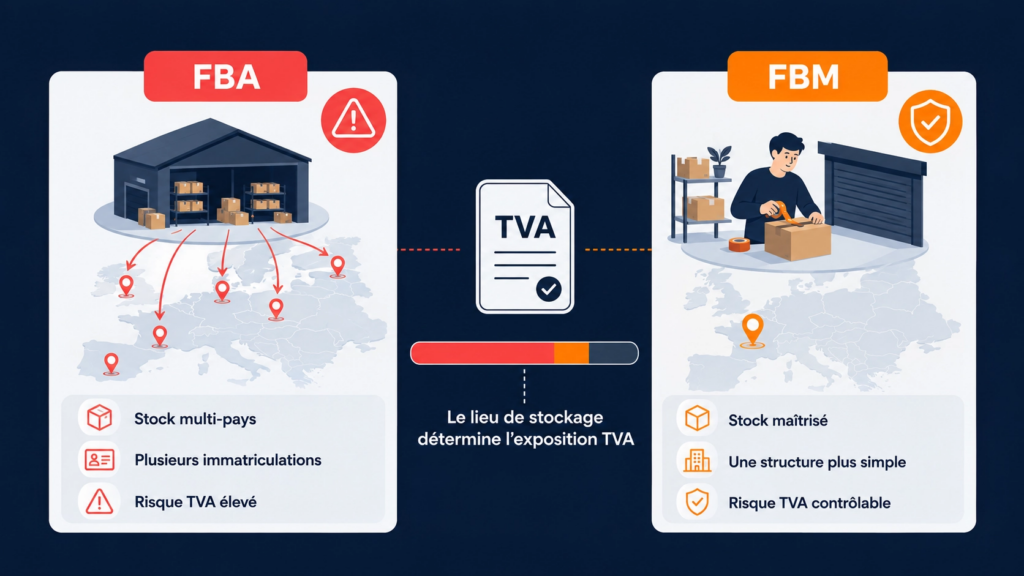
For FBA, the greatest risk lies in not knowing precisely which countries the stock is distributed in at any given time, particularly with the Pan-European program. This lack of visibility frequently leads to unanticipated liabilities in countries where the seller has never established a presence.
For FBM, however, the greatest risk lies in believing that the absence of Amazon storage exempts one from all tax monitoring. Silently exceeding the ten thousand euro threshold, or using a third-party warehouse abroad, actually creates obligations just as stringent as those of FBA.
What the OSS covers and what it doesn't cover
Le OSS diet It was designed to simplify the reporting of B2C distance sales made from a single country of establishment to other European Union countries. However, it does not cover the obligations arising simply from storing products in another country, which is precisely what the Pan-European FBA program addresses. A multi-country FBA seller therefore needs, in addition to the OSS (Order of Stores) where applicable, local registrations in each country of storage.
The most common VAT mistakes made by new Amazon sellers
Activate the Pan-EU before knowing your obligations
Many sellers activate the Pan-European FBA program as soon as it launches, attracted by the promise of fast Prime deliveries throughout Europe. However, they don't always anticipate that Amazon will distribute their stock across warehouses located in Germany, Italy, Spain, or Poland, nor do they always prepare the corresponding VAT registrations.
Confusing Amazon's collection with one's own compliance
Some sellers believe that Amazon, as a marketplace, assumes full responsibility for their tax compliance. In reality, Amazon's deemed supplier role only applies to certain well-defined categories of transactions. The seller therefore remains responsible for their registration, invoicing, and local tax filings in the countries where they store their goods.
Neglecting to track cross-border sales figures
An FBM seller who doesn't track their cumulative sales across all channels can unknowingly exceed the €10,000 threshold while continuing to charge VAT in their home country to customers located elsewhere in Europe. This error directly exposes them to a retroactive tax audit.
Leaving an invalid VAT number in Seller Central
Amazon requires that the VAT number entered in Seller Central exactly matches the company name and address registered with the relevant tax authority. An invalid, expired, or incorrectly entered number frequently results in sales restrictions or FBA inventory being blocked in the country concerned.
FBA or FBM: which model to choose to start in France
Situations where FBM remains preferable
FBM is particularly well-suited to a new seller who wants to maintain complete control over their storage location, who primarily sells from France, whose order volumes remain moderate, or who has the operational capacity to manage their own logistics. This model allows them to validate a market before investing in a more complex, multi-country organization.
Situations where FBA remains relevant
FBA nevertheless retains decisive advantages in several cases. It becomes relevant when access to the Prime badge constitutes a strategic lever for conversion, when the order volume justifies thelogistics optimization offered by Amazon, or when the seller has already implemented a multi-country tax tracking system. It also becomes recommended when the seller works with a specialized accountant and fully understands the storage program they are activating, whether it be national, European, or Pan-EU.
A three-step progression towards multi-country FBA
A phased approach significantly reduces risk. The first step is to validate the market in a single country, using FBM or single-country FBA, with clear registration and a well-defined invoicing process. The second step is to expand operations in a controlled manner, selling cross-border from a single warehouse, monitoring the €10,000 threshold, and assessing the benefits of OSS. The third and final step is to scale up operations with multi-country FBA, only after identifying potential storage locations and finalizing the necessary registrations.
VAT checklist before launching your Amazon business
Checks before the first stock shipment
Before any initial shipment of stock, it is recommended to follow a precise sequence of checks. First, identify the country where the company is established, then the country or countries where the products will be physically stored. Next, list the target marketplaces and sales countries, distinguish between B2C and B2B sales, and verify the applicable duty-free threshold in the country of establishment. Cross-border sales volume should also be monitored against the €10,000 threshold, while the benefits of OSS registration, or IOSS for imported products, should be assessed before any stock transfer to a new country.
Documents to keep up to date in Seller Central
Rigorous monitoring also involves keeping several documents up to date. The VAT number must remain valid for each country of storage and must exactly match the registered company name and address. Invoices must comply with European VAT requirements, while the stock movements Transactions between warehouses must be monitored monthly. A clear person responsible for VAT returns must be identified, whether an internal resource or an accountant, and this organization must be systematically checked after any change to the logistics program.
Frequently Asked Questions about Amazon FBA and FBM VAT
Is Amazon FBA subject to VAT in France?
Yes. As soon as products are stored in an Amazon warehouse located in France, registration for French VAT is generally required, regardless of the turnover achieved.
Does an Amazon FBM seller need to register for VAT?
This depends on the storage location and the volume of cross-border sales. An FBM seller who stores locally and exceeds the threshold of ten thousand euros in intra-community distance sales must register, or opt for the OSS.
What is the difference between FBA and FBM for VAT purposes?
FBA potentially multiplies the number of countries of registration due to Amazon's distributed storage, particularly via its Pan-European network. FBM, on the other hand, focuses the risk on monitoring the remote sales threshold and the potential use of a third-party warehouse abroad.
Is OSS sufficient to sell on Amazon FBA in Europe?
No. The OSS simplifies the reporting of B2C sales remotely from a single country, but it does not replace the local registration required as soon as an FBA stock is physically located in another country.
Does Amazon pay the VAT instead of the seller?
In certain specific cases, particularly for sellers not established in the European Union and for specific transactions, Amazon may act as a presumed supplier and collect the VAT due. However, this does not exempt the seller from their registration and reporting obligations in the countries where they store goods.
What happens if my Amazon VAT number is invalid?
Amazon may restrict selling rights or block FBA inventory in the country concerned if the VAT number provided is invalid, expired, or does not match the business name registered in Seller Central.
Amazon FBA France VAT: the choice that protects your business
Amazon FBA France VAT is therefore never simply a matter of choosing between two delivery methods. It impacts the company's tax structure from the very first product in stock, and it deserves the same level of attention as the choice of catalog or advertising strategy.
Three principles help to remember the essential This comparison reveals that FBA offers simplified logistics but exposes the company to potentially complex multi-country tax implications. FBM, on the other hand, facilitates VAT control but requires managing the entire supply chain in-house. Ultimately, the most suitable model remains the one that the company is truly capable of managing, both operationally and fiscally.
It is precisely this consistency between commercial ambition and management ability that distinguishes sellers who build a sustainable business on Amazon from those who suffer, a few months later, an account blockage or a costly tax catch-up.
Take action before your first stock shipment
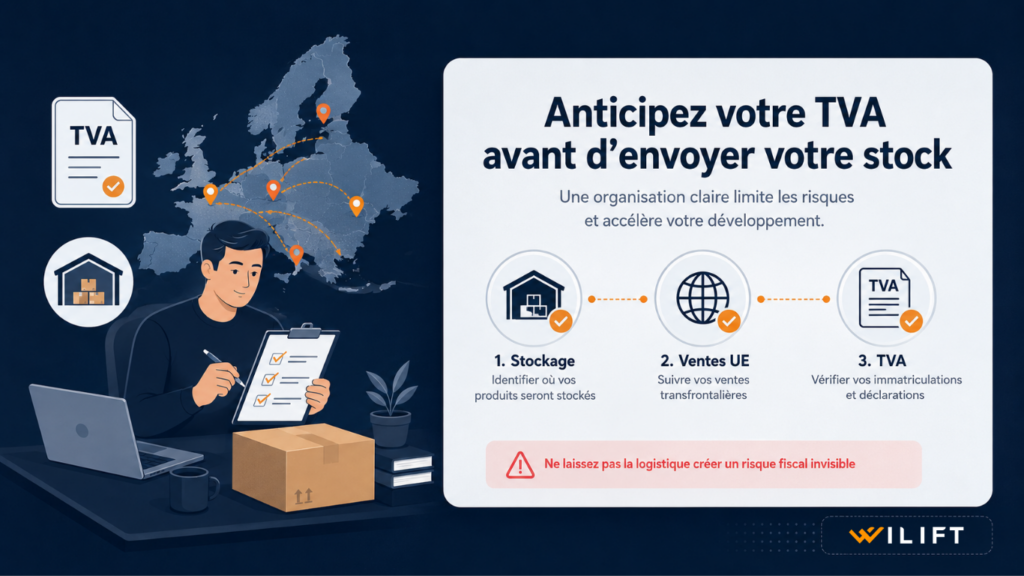
Before shipping any product to an Amazon warehouse or logistics provider, take the time to precisely map out where your products will be stored, which countries you sell to, and who will be responsible for your VAT returns. This advance preparation prevents the vast majority of account suspensions and late registrations seen among new sellers.
WILIFT We support Amazon sellers in structuring their catalog and managing their day-to-day operations. If you are preparing to expand into multi-country FBA, let's discuss how we can build a logistics and tax organization truly tailored to your level of maturity.
Disclaimer: This article is for informational purposes only and does not replace personalized tax or legal advice. VAT obligations may vary depending on the country of establishment, the type of business, the nature of the transactions, and the methods of storing and shipping goods. It is recommended that you review your situation with a chartered accountant or a specialized tax advisor before making any decisions.
Recent Comments